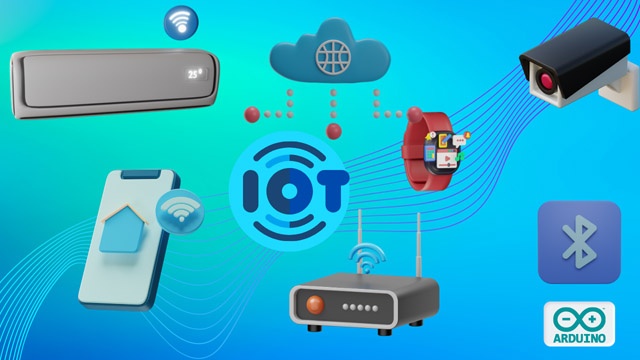
This concept of physical objects communicating and interacting with each other online is referred to as the Internet of Things or IoT. This online network of physical objects is accomplished through the use of types of sensors, actuators and RFID tags. Installing these tags inside a physical object gives it the ability to be monitored and controlled remotely through the Internet. This eliminates the need for humans to constantly enter and monitor data. Instead, objects can communicate directly with each other, without the need for a person to link them together.
IoT
Do you know that, computers, smartphones and tablets are not only the objects, which are able to connect to the Internet?
Nowadays, nearly everything around us — from animals and household lights to human beings and cars — has the ability to be brought online to interact with other machines.
Course Features:
- Language: English
- Track: New Collar Track
- Duration: 60 hours
- Level: Foundation
- Learning Mode:
- Jurisdiction: Nationwide
- Certificate of Completion
Eligibility
- Learner should preferably a std. 10th Pass student (Not Compulsory)
- It is desirable that Learner should have done MS-CIT Course (Not Compulsory)
Introduction
Who Should Join
- Electronics and Engineering Students studying electronics, electrical engineering, or computer science who want hands-on experience with IoT systems and hardware.
- Aspiring IoT Developers interested in building IoT solutions, such as home automation systems, smart devices, and sensor-based projects.
- Professionals in IT, automation or Embedded Systems who want to enhance their knowledge of IoT technologies.
- Beginners in Electronics – Individuals with a basic understanding of electronics and programming who want to explore how IoT devices are developed and controlled.
- Individuals who enjoy DIY electronics projects and want to learn how to create smart systems using Arduino, NodeMCU, and sensors.
- Educators and Trainers who are developing IoT-related curricula and want to understand the tools and projects that can be implemented.
- Business owners or innovators interested in exploring IoT for developing smart products or solutions.
What you'll learn ?
If you are curious about how devices are controlled remotely using mobile devices then this course is for you….
In the course, learner will examine the concept of IoT. Learner will also look at the ‘things’ that make up the Internet of Things, including how those components are connected together, how they communicate, and how they add value to the generated data. After completing this course learner can design and built IoT system for home/office.
After completing this course, Learner may get various Career Opportunities like:
- IoT System Design Engineer.
- IoT software developer.
- IoT product manager.
- IoT solution Architect.
- IoT research developer.
- IoT service manager and so on…
Syllabus
- Introduction to IOT
- Introduction to Arduino Board
- Arduino IDE
- TinkerCAD
- Breadboard
- LED Bar
- Piezo Buzzer
- Serial Monitor
- Push Button
- Proximity Sensor
- Temperature and Humidity Sensor
- Ultrasonic Sensor
- LCD
- LDR Sensor
- DC Motor
- Servo Motor
- RFID
- Bluetooth Communication
- RTC Module
- Introduction to NodeMCU
- NodeMCU-Blynk-DHT
- Case Study-Home Automation
- IOT Projects for Practice
Certificate
- MKCL provides certificate (for 30/60/90 hours courses) to the DEEP learner after his/her successful course completion.
Academic Approach
The Academic Approach of the course focuses on the “work centric” education i.e. begin with work (and not from a book !), derive knowledge from work and apply that knowledge to make the work more wholesome, useful and delightful. The ultimate objective is to empower the Learner to engage in socially useful and productive work. It aims at leading the learner to his/her rewarding career as well as development of the society.
Learning methodology
- Learners are given an overview of the course and its connection to life and work.
- Learners are then exposed to the specific tool(s) used in the course through the various real-life applications of the tool(s).
- Learners are then acquainted with the careers and the hierarchy of roles they can perform at workplaces after attaining increasing levels of mastery over the tool(s).
- Learners are then acquainted with the architecture of the tool or Tool Map so as to appreciate various parts of the tool, their functions and their inter-relations.
- Learners are then exposed to simple application development methodology by using the tool at the beginner’s level
- Learners then perform the differential skills related to the use of the tool to improve the given ready-made outputs.
- Learners are then engaged in appreciation of real-life case studies developed by the experts.
- Learners are then encouraged to proceed from appreciation to imitation of the experts.
- After imitation experience, they are required to improve the expert’s outputs so that they proceed from mere imitation to emulation.
- Finally, they develop the integral skills involving optimal methods and best practices to produce useful outputs right from scratch, publish them in their ePortfolio and thereby proceed from emulation to self-expression.
Evaluation Pattern
Evaluation Pattern of DEEP Courses consists of 4 Sections as per below table:
| Section No. | Section Name | Total Marks | Minimum Passing Marks |
|---|---|---|---|
| 1 | Learning Progression | 25 | 10 |
| 2 | Internal Assessment | 25 | 10 |
| 3 | Final Online Examination | 50 | 20 |
| Total | 100 | 40 | |
| 4 | SUPWs (Socially Useful and Productive Work in form of Assignments) | 5 Assignments | 2 Assignments to be Completed & Uploaded |
MKCL’s DEEP Certificate will be provided to the learner who will satisfy the below criteria:
- Learners who have successfully completed above mentioned 3 Sections i.e. Section 1, Section 2 and Section 3
- Additionally, learner should have completed Section 4 (i.e. Section 4 will comprise of SUPWs i.e. Socially Useful and Productive Work in form of Assignments)
- Learner has to complete and upload minimum 2 out of 5 Assignments
Courses Fee Structure from 01 July, 2025 Onwards
DEEP 60 hour course fee applicable from 01 July, 2025.| DEEP Course Duration 60 Hours | ALC Share (Service Charges to be collected by ALC) |
MKCL Certificate |
|---|---|---|
| Single Installment | Rs. 2250/- | Available |
| Double Installment | Rs. 2300/- | Available |
Important Points:
* Above mentioned fee is applicable for all Modes of DEEP Courses offered at Authorised Learning Center (ALC) and at Satellite Center
* Total fee is including of Course fees, Examination fees and Certification fees
* MKCL reserves the right to modify the Fee anytime without any prior notice
* Above mentioned fee is applicable for all Modes of DEEP Courses offered at Authorised Learning Center (ALC) and at Satellite Center
* Total fee is including of Course fees, Examination fees and Certification fees
* MKCL reserves the right to modify the Fee anytime without any prior notice
View Courses on Offer